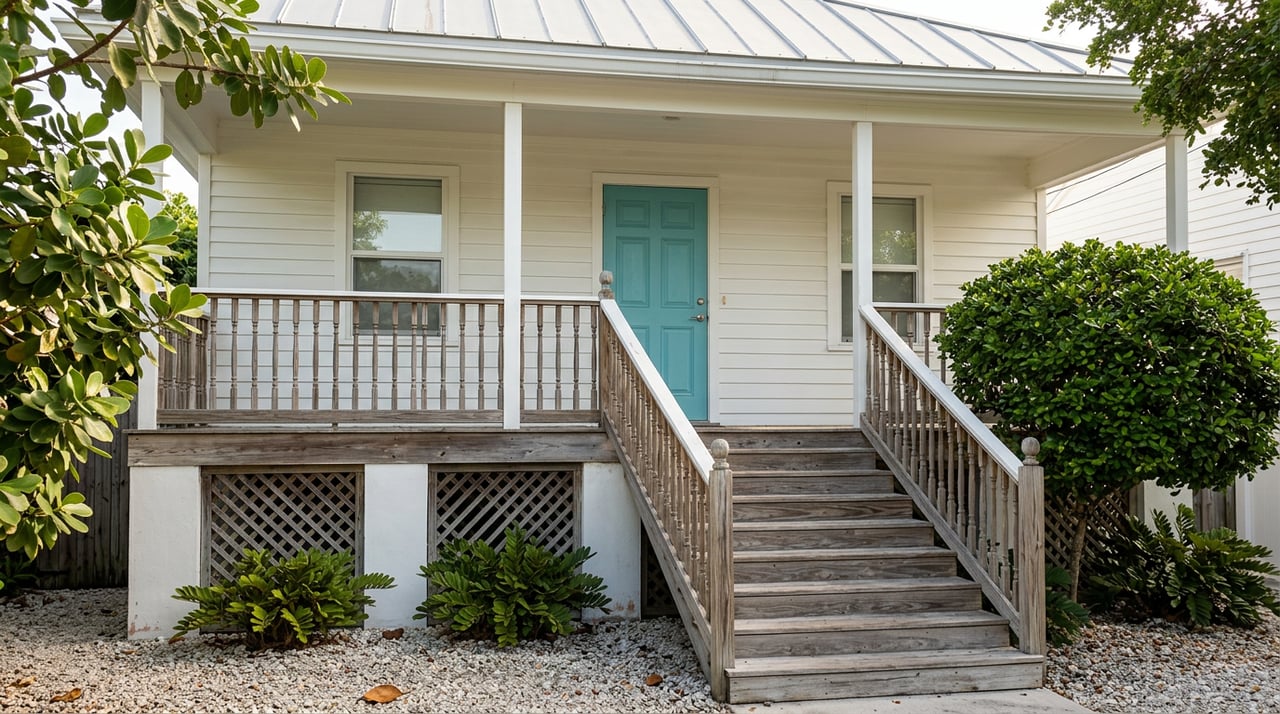
Why would two homes on the same 4.2-square-mile island, both a short walk from Duval Street's edge, list a half-million dollars apart with no obvious difference in size or condition? The easy answer is charm. Old Town has the conch houses, the brick lanes, the century of storytelling wrapped into every wraparound porch. New Town has the parking and the practicality. Charm costs money. Case closed.
Except charm doesn't explain a price gap this specific, and it doesn't explain why that gap is moving in two different directions right now for two entirely different reasons. One neighborhood-level tracking source pegs Old Town's trailing 12-month median sale price at roughly $1.45 million against $850,000 in New Town, a spread wide enough that it can't be architecture alone. Citywide median figures bounce around depending on which source you check: Zillow put the typical Key West home value at $1,095,596 as of June 30, 2026, up 2.4% year over year, while Redfin reported a median sale price near $1.0 million in February 2026, down 14.3% from the prior year. When two reputable trackers disagree by that much on the same city in the same year, the citywide number is telling you less than you think. The real story lives in the split between Old Town and everywhere east of it, and two specific, largely invisible mechanisms are doing most of the work.
The License That Doesn't Come With the House
Key West stopped issuing new transient rental licenses in most residential zoning districts in 2018. That single administrative decision froze the supply of legally licensed short-term rentals in a city built on tourism, and it means a home's ability to rent nightly is no longer something a buyer can simply apply for. It has to already exist on the property, and even then it doesn't move the way most people assume.
A grandfathered license does not transfer automatically when a house sells. The license lives with the business use, not the deed, and buyers who assume a listing's rental history comes bundled with the closing have been surprised at the table more than once. Because the pool of eligible licenses is fixed and the demand for licensed vacation rental income is not, licenses have changed hands on the secondary market for figures in the $400,000 to $500,000 range in recent years, priced and negotiated separately from the real estate itself.
Truman Annex properties add another wrinkle. Some carry what's known locally as a Special Transient License, a category tied to a weekly minimum stay and a sunset clause, distinct from the standard transient license that applies elsewhere in the city. The legal footing for a lot of this dates back to a 1997 city ordinance and a Third District Court of Appeal case, Rollison v. City of Key West, which recognized a Truman Annex unit's pre-1998 rental use as a legal nonconforming use under what the code calls the "50% Rule." You can read the current version of that framework directly in the city's transient living accommodations ordinance.
Old Town and its immediate surroundings hold most of the city's grandfathered licenses simply because that's where transient use was already concentrated before the 2018 cutoff. New Town, largely residential and zoned for permanent housing, has far fewer eligible properties to begin with. That geographic accident of licensing history is baked into today's Old Town premium whether or not the buyer ever plans to run a rental.
Here's what a license actually restricts, in practice:
- No new transient licenses are being issued in most residential zoning districts, full stop
- A license does not convey with a property sale and must be separately verified with the city's Licensing Division
- Even where zoning allows transient use, HOA or condo documents can restrict it further
- Enforcement includes daily fines, and Airbnb and VRBO will delist properties flagged as non-compliant by the city
The Ground Old Town Was Built On
The second mechanism has nothing to do with tourism and everything to do with topography. Old Town sits on the highest natural elevation on the island. That's not a marketing phrase, it's a mapping fact the City of Key West's own planning documents acknowledge, and it's why a meaningful share of Old Town properties have historically sat in FEMA's Zone X, the flood designation that has not required mandatory flood insurance.
That exemption has real dollar value. A home that doesn't need a flood policy to get a mortgage has a lower true carrying cost than an identical home a few blocks away in a mapped high-risk zone, and buyers comparing a New Town listing to an Old Town one are often comparing two very different insurance realities without realizing it.
That advantage is shrinking. The City of Key West has confirmed that roughly 2,000 buildings currently sitting in the X Zone are being remapped into AE-type flood zones as FEMA's flood maps update, a change the city addresses directly on its online flood maps page. Keys Weekly, covering the same remapping process, reported that the X Zone is projected to shrink to roughly one third of its current size, meaning two thirds of those properties will be required to carry flood insurance for the first time. That's a Keys Weekly figure from an earlier round of remapping, and the direction of travel has continued since: FEMA's more recent Risk Rating 2.0 system prices flood risk by a property's specific elevation and distance to water rather than by zone label alone, so even homes that keep an X designation on paper are being priced closer to their actual exposure.
For buyers, the practical tool here is the Elevation Certificate. The city notes that for buildings constructed before 1975 and not built at ground level, having a certificate on file can meaningfully lower flood insurance rates, and without one, FEMA has no record of how high a structure actually sits, which means rates keep climbing even after they should have leveled off. You can find the details on the city's Elevation Certificates page. A property owner on naturally high ground can also pursue a Letter of Map Amendment to formally document that elevation, a process distinct from a Letter of Map Revision Based on Fill, which applies to land raised artificially rather than by nature.
Two Premiums, Moving in Opposite Directions
| Mechanism | What it does to Old Town's premium | Direction right now |
|---|---|---|
| Frozen transient rental license supply | Concentrates rental income potential in and near the historic core, priced separately from the house | Rising, as fixed license supply meets steady tourism demand |
| High-ground flood exemption | Historically lowered insurance costs relative to New Town | Shrinking, as remapping and Risk Rating 2.0 erode the X Zone advantage |
That table is the whole point of this post. Buyers evaluating Old Town's price tag against New Town's are really pricing two separate assets bundled into one deed: a scarce rental license that's becoming more valuable because nobody can create more of it, and a flood-zone advantage that's becoming less valuable because FEMA keeps redrawing the lines that protect it. A listing that leans on both looks like a stable premium. A listing that only has one is more exposed to whichever trend is working against it.
What This Means Before You Write an Offer
If you're comparing a $850,000 New Town home to a $1.45 million Old Town home, the difference is not simply what each one is. It's what each one can legally do and how exposed it is to two regulatory forces that don't move in sync. Before treating either premium as fixed, verify:
- Whether the Old Town property carries a grandfathered transient license, and confirm directly with the city's Licensing Division that the license is active and what its renewal history looks like, since it will not transfer automatically at closing
- Whether the property has a current Elevation Certificate on file, and what flood zone it sits in under FEMA's most recent maps rather than an older designation the seller may be quoting from memory
- Whether the seller has an existing flood policy that can be assumed, since a policy in place before a remapping event can lock in a lower rate for a new owner
None of this is legal or tax advice, and both the licensing and flood-zone questions deserve a conversation with the city's Planning Department, a qualified insurance agent, and your own attorney before you rely on them in a contract. But knowing which questions to ask is the difference between paying for a story and pricing an asset.
A Short FAQ
Does a transient rental license automatically transfer when I buy a licensed home in Key West? No. The license is tied to the business use and licensing history, not the deed, and buyers need to verify its status separately with the city before assuming any rental income will continue.
Can I get a new short-term rental license if I buy in New Town? Generally no. The city stopped accepting new transient license applications in most residential zoning districts in 2018, and New Town is overwhelmingly zoned residential, so new licenses there are not typically available.
If my Old Town home is in Zone X today, will it stay that way? Not necessarily. FEMA's remapping has already moved a significant share of X Zone buildings, most of them in Old Town, into higher-risk designations, and Risk Rating 2.0 now prices flood exposure by a property's specific elevation rather than by zone label alone.
If you're weighing an Old Town listing against something in New Town, or trying to figure out what a specific rental license or flood designation is actually worth on a property you're considering, Ocean SIR can walk you through the paperwork before you write an offer. Request a Home Valuation and we'll help you separate the price of the house from the price of everything attached to it.